
Any good partnership should push its constituents into uncomfortable places. Wisdom is an unwanted chaperone, best avoided.
A set of consulting projects took me into the southern edges of British Columbia. I found glaciers that clung to the sides of massive stone spires, rich, emerald forests, and broad river valleys. Clouds, white and grey, galloped through moody skies scattering the sunlight into heavy golden lances that pinned me to each place they touched. I was forever transfixed into the horizon, staring into the movement of light over the land, or snared by the faint trails and fire roads that beckoned me.
No matter how hard I concentrated on any one thing, something else always glinted in the periphery of my vision. It was impossible to fully absorb such a complicated landscape even though I was completely committed to the effort. The logistics of business travel prevented me from bringing a bike, but I did manage to ride the coattails of meetings off into extended trail runs. Slush, snow, and rain found me on tight, rocky trails and mossy logging roads with a small flashlight clutched in cold fingers.
I don’t usually look to my parents as enablers of adultery, but my Mom was all too obliging. She and her husband moved from Colorado to a small town an hour north of Spokane, Washington. Given her new location I had both the motivation (abundant), and the means to look for riding trysts beyond our beloved Vermont. Even more importantly, she offered childcare. Dad contributed a tandem shipping case and two sets of red panniers that looked sharp on HAHA’s bright blue frame. My Mom’s husband lent us his truck and my wife brought her unflagging enthusiasm. I applied myself to the maps. Digital research with MapQuest helped me to calculate both distance and elevation for a four-day loop in the area of Nelson. Booking hotels enabled us to travel light but also meant that we would have to achieve set distances each day.
Day one was a 70 km jaunt from Salmo to Creston, with Kootenay Pass as the central feature of the ride. A few thousand Vermont miles and almost twenty years of marriage prepared us to tackle long climbs, but this would be the first time we had to work through 22 kilometers and more than 1000 meters of elevation in a single go.
Time in the Colorado high country taught me that it is best to get over passes before the afternoon thunderstorms gather around the peaks. My planning included an early departure on our first day, but my schedule was derailed by Mom’s scheming. I don’t recall the details of the activity she organized for the girls but sticking around for a couple of hours seemed more important than my perpetual early-start anxiety. For someone doing normal cycling math, my nerves were hard to justify. There would be plenty of August sunshine that far north even with an afternoon start. In the high country, however, calculations should be done with different variables.
The drive up went entirely as planned. We had no issues at the small border crossing, and the growing intensity of the mountains heightened our excitement. In Salmo, we found a restaurant that had a large parking lot and an open door. A quick inquiry confirmed they didn’t mind us leaving the truck in their lot for a few days. In minutes we had the bike outfitted with all four panniers, slapped on sunscreen, and donned our water packs. We hit the road in the bright sunshine of the early afternoon, and we had the first fifteen kilometers to warm up before we started on the pass.
In British Columbia the rugged alpine terrain shows up at much lower elevations. The mountains around us maxed out at around 2000 meters but still towered as the kind of massive stone spires I associated with 14ers of Colorado. The woods were dense, emerald, and mossy. Glaciers stood as reminders that more snow fell through the long, wet winters than the brief weeks of summer sun could erase. Water flowed everywhere: thin veils streamed off of the peaks, bright white lines broke through the dark green mountainsides, vast lakes and fearsome rivers sparkled in the deepest valleys. Constantly scoured by so much water and ice, the sides of these peaks were steeper than most of what I found in Colorado.
The climb began in the way of most passes. We rode beside a tumbling creek whose large size told me a lot about how much space was above us. I selected the smallest ring up front and we moved through a slow strobe of tree shadows. We filled our heads with the roaring water, welcomed the sweaty brine that glossed us, cozied up to the bright sun and relaxed into the cool air. We settled in to do the work.
The road turned away from the stream sooner than I had anticipated. The climb intensified by a degree or so, but was still in a familiar range of intensity. I alternated between the two biggest gears on the rear cluster as we zigged and zagged across the skirts of the mountain range. The engineers had done fine work finding a comparatively gentle angle for a road that cut through such precipitous terrain.
With each pedal stroke the valley sank further into haze, became more of a feature, less of a place––a remote, improbable nook of sun and orchards that we could hardly imagine, much less remember. Above, impending, dark clouds boiled around the peaks. We were going to get wet––probably catch a light show as well, but I expected that the pass was deep enough to protect us from real danger.
The first rumbles reached us somewhere close to the one-third mark. Though Daysi claimed she wasn’t worried, power surged through the drive chain with each roll of thunder. Legs were no longer fresh, but we were still strong on the pedals. The road took us off of the skirts into a high valley where the ridges came in closer and rose higher. The improbable, fantastical valley where we had started was locked away behind grey gates of stone and cloud. Progress was harder to measure in these shadowed lands. We persisted in the patient, tiny steps of a steady cadence, and as we continued up the clouds moved lower. Bright flashes alerted us to the baritone waves that broke hard around us and faded through their own echoes. We were smaller in this grey and roiling landscape. We persisted.
It was colder here. We stopped to layer up. The higher we climbed the more grateful I was for every minute without rain. We were on borrowed time, but we continued our advance and the clouds continued their march down to meet us –– ever darker but for the bright flashes. The thunder sometimes vibrated in my chest before it cascaded away through its own echoes.
The pass ended with a whimper.
I was prepared for a final, steep push through narrow switchbacks, precarious engineering and vertiginous views. Instead, the road gradually flattened as it moved through a broad gap and around a sizable lake. Just where the grade flattened, our luck dissolved into the boiling clouds. A few minutes of light showers suggested clemency before the sky collapsed into a cascade of falling water and frigid air. Finally! The suspense broke. We hunched shoulders, picked up the cadence and aimed for escape.
Salvation emerged through the grey light a few hundred meters off to the right. Rain hammered a howling racket on a large sheet-metal building that was easier to hear than see. Closer, the entrance towered three meters above us, wide enough for several large trucks. I pointed HAHA straight through the gloom and coasted into the dark throat of the structure. Like any small mammal, we scurried into the furthest corner, stood against a wall, and turned, wide-eyed, to stare into the howling storm. Tractor tracks and traces of road salt let me guess that the sheet metal shed was big enough for a winter’s worth of salt and equipment to move it.
Our breath condensed, grey in the darkness. At least we were out of the onslaught. Rain hammered metal. Talking was impossible; didn’t even try. We dug through the panniers to pull out all remaining layers, and then stood together, in the roar. From the darkness of the shed I stared out into the grey sheets as they swirled, shifted and blurred the pine groves. The road was only a few meters beyond the opening––invisible. No cars passed.
I began the uncomfortable calculus of hypothermia. Because the wind had already started to weaken I bet on this being a “quick” mountain downpour. How quick? How long did we have? How long could we safely rest? How long could we survive in the cold, soaking rain? At one extreme I knew that spending a night this way would be bad. On the other, dashing out into the torrent of cold water to bomb down the pass also seemed foolish. Breath clouded my glasses. Heat of the climb drained away. We should wait for a break, not even a perfect break –– just something better than this. The weather had gathered around the peaks, it ought to open up as we descended. I hoped.
We had climbed for well over an hour. Maybe three. Generally it is best not to do that kind of math on a long pull, but it would have been helpful now. I worked on these problems without speaking but could hardly hear even my own thoughts through the racket of rain on metal.
I leaned into Daysi’s ear and shouted, “We should eat something.”
I moved my ear near to her mouth. “I’m not really hungry,” she hollered.
“Me either, but we need the calories.”
Side by side, with fistfuls of trail mix we chewed and stared into the rain. I sealed the bag and bent over to tuck it into the designated corner of my pannier.
SILENCE.
I looked up.
Snow –– large, heavy, wet flakes fell straight, hard like rain, but soundless. Snow that was almost water meant that the ground might stay warm enough to prevent ice. Even so, it fell hard, dense. The tops of stones turned white. My already limited view of the pine groves became even blurrier as the needles took on winter camouflage in the heart of August. I felt every centimeter of my clammy surface; the chill sank deeper. My wife, I knew, was smaller and more prone to cold.
I no longer needed to shout.
“How are you doing?”
“Cold, but I think okay.”
“We can’t stay much longer.”
“Why not?”
“We are going to get too cold.”
“Okay” There was uncertainty in her voice, and unwillingness to ask more questions.
We stared into the white wall, and waited. We stood still. The world raged around us. I knew that our stillness was a danger, and yet I was hypnotized by the silent beauty of the falling snow and fixed in the sudden severity or our circumstances. At least, I remained sharp. My silence, my stillness was, as yet, more the coil of anticipation than the lethargy of hypothermia; still ready to fight, but for how much longer?
The snow stopped.
We rolled out of the salt shed fully mounted. Flurries still danced around us. HAHA cut a shallow trail through the slush on the dirt lot. Pavement was only wet. We were not yet on the backside of the pass, so I threw us into the big chain ring. We pushed hard, but it didn't last long. Within a few hundred meters we were on a downward angle that provided no resistance in even our tightest gear. We had only enough climbing to take a few hard breaths and get a flicker of lactic fire in the quads. Not enough. There was no ice, but the spray off of the road was thick, viscous, freezing. I was full in the teeth of the wind. Faster to get through this? Slower, to reduce the cooling? Fingers became more abstract.
BAM!
Ten centimeters of thick slush covered the road. The weight of two riders and gear on 35 mm tires cut hard enough to keep rubber on the pavement. But what about ice? This same force equation would work against us. Two riders, already on the verge of hypothermia, sliding through the slush into the guard rail? Over an edge? Into a car? The image was only a flicker. Vision narrowed. Where a car had passed I found a channel. In this gap only water covered the pavement. But we were in the middle of the road, walls of slush on either side. The melting snow followed my same logic; concentrated its icy flow in this thin channel. Shivering began.
The first car off the road was on our side –– over against the guardrail. I swerved out of the channel; nothing more than blind faith when I could no longer see where wheels met the pavement. Not much damage on the vehicle, and we were in no condition to stop. The next one was on the other side of the road up against the mountain. Flashing lights meant a cop was already beside them. I considered, briefly, easing HAHA to a stop and asking for help. I saw us stripped down in the back of the heated cruiser. Maybe people were already in there. Get off the road. Get away from spinning cars. I shivered through my whole body, but I could still feel enough of the brakes.
“Days, we have to get the fuck off of this mountain.” I shouted back. No response.
The runoff opened a channel of visible pavement over on the shoulder. I eased HAHA diagonally through the slush into that channel. No longer in the middle of the road; relief. But barely-visible, unknown shoulder pavement. How fast would be too fast? Our experience helped. We held our tuck and kept ourselves butt-up; prepared, within limits, to absorb unexpected hits. Light pressure on the brakes reminded me that I had hands. I wondered if Daysi’s thighs were shivering like mine. Most of the channel was blessedly straight, but deep. The spray was generous––frigid bath to feet to thighs to chest––the entire world became a ten centimeter channel of flowing water; wheel in the center. Where the stream swerved, I trusted the traction and aimed for the next bit where our purpose aligned with the water. Fortunately the road was mostly straight and the pavement smooth.
As suddenly as it had appeared the slush was gone. Was this ten minutes? Was it an hour? Was it two minutes? Out of the ice bath, on clear pavement; relief. Air started to warm. Shivering left my legs. I tentatively concluded that we had survived.
The brake levers were out there, somewhere below my elbows. I concentrated on the memory of clenched fists until the bike started to slow. With greater concentration HAHA eased to a stop. I felt for the pavement with the end of my left leg, and I found resistance about where I would have expected it. A fuzzy ache confirmed contact. I paused, tested for balance and then popped the other foot out of its pedal.
Thanks to tandem physics, Daysi received less of the icewater and was in the lee of the wind. Without dismounting I turned to ask if I could warm my fingers. She winced when I stuffed my numb hands and wet gloves into her arm pits but clamped her arms tight over them. My hands were so close to her core that I could feel she was not shivering.
“You warm enough?”
“I’ll be okay. Seems better now.” She wasn’t smiling, but there was no fear in her face.
I looked over her left shoulder up into the late afternoon light. My eyes followed the cut of the road as it climbed the mountain. It looked like any other big climb.
I left my hands just long enough to feel individual fingers. Then I turned to look back down the path of our descent, and across big views to the East and the South. The late afternoon sun angled across the land and had already settled into more honeyed tones. A patch of bright sun across the road below us promised more warmth ahead; time to go find it. No more than thirty minutes later we stopped again to shed layers.
We rolled into Creston on a warm summer evening. We had taken full advantage of the long twilight to get this far. The hotel, once we found it, was little more than a few rooms tucked into the second floor over a pub––clean and cozy.
HAHA barely fit along the far wall under the window. We covered every inch of the frame in layers of sodden gear. Hotel towels joined the moldering collection after our hot shower. We dug in the bottoms of our panniers for that single change of cotton clothing wrapped in multiple plastic bags. Dry. Warm. Clean; bland adjectives I was happy to celebrate
We didn’t make it down to the pub until after 8:00 pm. Dim lighting and dark decor made it feel smaller than it was. We passed through the door into a babble of laughter, stories, jibes and flirting. So much. So many. So loud. Tire hum, chain clatter, and whistling breeze were all suddenly faint, fragile and distant. When the bartender smiled and told us to take any table I was astonished that her conversational tone cut through the racket. As the room came into focus I found fewer than a dozen souls. Most were gathered around a pool table at the far edge of the pub.
We took over a corner bench behind the bar. The flickery, cool blue glow of a half-dozen big screens competed with, and mostly lost to, the yellow glow of weak bulbs. My mood was attuned to the dim, the snug, the dark –– ruled by the singular desire to curl up in a burrow and annoyed that I could not look up without confronting the piercing rays of those screens. I was further disappointed by how I let the jostling pixels pull me out into the brightly lit fields of summer olympic games over in the U.K. Cameras cut from stadiums, to fans, to athletes, to action. So fast. So bright. Though the screen was muted I could feel commentators shouting in those big announcer voices over roaring crowds. Not my world. Not my place.
I wanted the halflight, the soft T-shirt, Daysi’s hand, the cold richness of my pint –– bitter and bright over the tongue –– to sink into a puddle of languid flesh. Burger and fries please. Yes, medium. Sure the salad too. Blue cheese please. The alcohol mixed with residual adrenaline and the gentle endorphin glow. She leaned against me. The heat and weight of her body held the cold, bright screens at bay.
We could have died today.
But can’t you say that most every day?
Sure, but not quite so up close and personal like.
No shit.
That was close. You did great.
We just had to get off the damn mountain to someplace warmer.
Won’t forget about that one anytime soon.
Fuck no.
We made it.
Yep.
Tomorrow’s another day.
Probably a whole lot easier.
Couldn’t be harder.
There was no need for the obscene fleshiness of flapping jaws. The fold of my arm around her waist and the warmth of her hand over mine said all we needed.
Our fellow patrons were as remote as England –– would that I could mute them too. There was yet some piece of the mountain that lingered between us and them. My lips found the edge of her ear, lost in the lazy wholeness of each body and creeping drowsiness. Through the curve of her back against my soft belly I felt the steady ebb and flow of her ribs –– each breath a sensual and celebratory thing.
Opening the door to our room was like climbing under the lid of a compost bin. Yes it is possible to gag while laughing. Everything was drying out, except for the room itself –– soaked in the humid funk of drenched and sweaty humans. Despite the encroaching cold of the north-country night, we threw open the windows and snuggled deeper into the covers –– two bright embers banked against the damp and the darkness.
The next morning we left early, and figured that breakfast would find us on the route. The day was cool and cloud-dappled. We worked through rolling country that took us to and from the shore line. We had expansive views of sharp peaks rising above the forests on the far side of the lake. The unique pace of cycling fit our side perfectly. Moving any faster would have created friction between us and the surrounding beauty. Excessive focus on the road would have made us less distractible. I don’t recall much in the way of convenience stores but cottage industry abounded. Fresh raspberries, sure. Hazelnuts, absolutely. Local honey, oh yes. Home made brownies, oh hell yes. Graze a bit. Chat a bit. Load up and roll. Lazy progress was sufficient for the day.
Despite the bright sun, the breeze on the docks was cool enough for us to break out light jackets while we waited for the ferry to take us to the western shore. We found the only small ring riding of the day as we continued north up to our hotel at the Ainsworth Hot Springs. Even these were only short pulls. We knew that we would cover this territory again tomorrow when we rode back to Nelson to meet Mom and the girls.
When I think about a great day of bike touring this one comes to mind. We had clocked more than ninety kilometers through some of the world’s most spectacular scenery. The long summer hours made it feel like we had all the time in the world. No curiosity was too trivial for a stop, and a few minutes in the hot springs pool was a nice way to wrap up the day.
The next day was light riding. We were in no hurry to get out the door and then spent most of the afternoon in Nelson napping beside the lake while we waited for Mom and the girls to arrive. The weather was much warmer. By the time we met them at the hotel we were already rested, and, after a shower, filled them in on our adventures. Mom managed to find a room that fit the five of us. We thought this was great team building for the family until Mom settled into a snoring jag that kept us awake most of the night.
The next day was forecasted to be even hotter. This would be our longest day, with a significant pass somewhere around the two thirds mark. We set out earlier enough to hit the pass before storms built up. When we left Nelson through the valley on the backside of Sentinel Mountain we found consistent easy riding –– more fields than hills. The traffic was only intense when we moved through towns. The heat, however, came on hard. By 11:00 we struggled to keep our water packs filled. We stopped to throw a couple of extra water bottles into the panniers at the last town before the pass.
We hit the base of the climb sometime before 1:00. Given our goal to avoid the late afternoon storms, the timing wasn’t bad, but the heat sizzled at close to 35C. The road was modern, well-engineered and broader than Kootenay pass had been. At that hour of the day, there was absolutely no shade. If not for our fear of the storms, we would have been wise to hunker down and wait for cooler hours. So far, even the peaks were clear, but we knew how quickly the view could change.
We launched into the ascent with roughly 75 kilometers behind us and the expectation that this climb would be something less than twenty kilometers. For almost an hour we labored up the pass, took breaks when it seemed like we might overheat and sucked down water. We were reaching that point in the day when we needed an actual rest, but wanted to get out of the sun. Daysi finally figured out a solution. When we came to one of the road cuts through a small ridge she noticed that the angle of the construction created a small patch of shade partway up the bank. We grabbed nuts and the spare water bottles before scrambling up the slope to a spot where we could get part of our bodies into some shade. The height of the slope also gave us more exposure to the mild breeze. We estimated that we were somewhere between one third and half way up. The skies remained clear, and there was almost no traffic. Now that the risks of another near-death experience appeared minimal we could relax.
Perched up in the cut, we looked down on HAHA sparkling blue in the bright sun. The view up the pass hid behind the embankments but we could see down into the valley where we had started. The commercial sprawl was already a remote memory. We felt the weight of the miles and a bit of that unique fatigue that comes from high heat, and we could feel that our strength was up to the task. Neither of us was ready to pull out Grampa’s trademark “It’s all downhill from here,” but, by now, we had earned a bit of swagger. A few minutes of dozing in our scrap of shade set us up to burn through the remaining elevation and there was no reason to fear the handful of kilometers that separated us from the car after that.
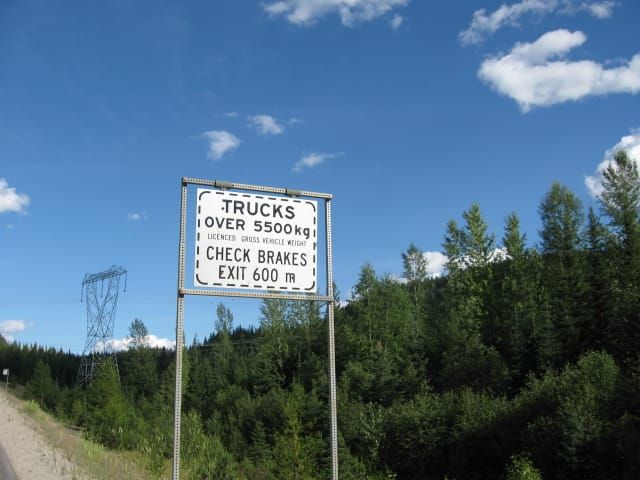
For the remainder of the climb we had the dual advantages of temperatures that dropped at higher elevations and a sun that cooled as it fell towards the horizon. We settled in to grind. I stopped us shy of the crest to snap a picture of the “Trucks test brakes” sign that is the beacon of hope for cyclists everywhere. On the other side I was surprised to find a mostly straight, completely wide open, and totally empty road with perfect pavement. Eight kilometers and 800 meters of elevation. I never even tapped the brakes. Daysi whooped out loud behind me.
 buy me a coffee
Member discussion: